Why does my toddler cry at drop-off?
Written by Matt MaLossi, parent behind How They're Wired. Last reviewed October 19, 2026.
The short answer. Some distress at goodbyes is a normal part of development, and some children feel it more because they are cautious in unfamiliar places or with unfamiliar people. For most children it eases as they get comfortable with the place and the people. If it lasts for weeks and starts getting in the way of school, friends or activities, it's worth asking your pediatrician.[1]
Try first. Keep the goodbye short and calm, do it the same way every day, and don't sneak away.
1 of 6
Why does my toddler cry at daycare drop-off?
Separation distress usually starts in the first year, peaks around 14 to 18 months, and fades through early childhood.[2] Some toddlers skip it as babies and start at 15 or 18 months. It is rare for it to continue daily after the preschool years.[3] It can come back at other times of stress.[4]
Our reasoning Daycare drop-off puts that on a schedule: the same goodbye every morning, often in a busy room. Crying at the door is one common way a young child shows it.
2 of 6
Why does my child cry at preschool drop-off?
Our reasoning At 3 and 4, children are more aware of what's coming. Some are cautious in new places or with new adults, and drop-off asks them to meet both at once.
A long-running study found that children who stayed cautious for years were more likely to have social worry later, but most of them did not.[5]
Our reasoning How different adults see your child may differ too. In a study of 365 children aged 3 to 4, parents, teachers and trained observers agreed only modestly about the same child's behavior, and the authors say the ratings were clearly not interchangeable.[6] A child who cries at the door may look different to the teacher an hour later. Both views are real.
3 of 6
Why is school drop-off hard for my child?
Starting school, a new teacher, a new class, or coming back after a break can bring distress back. Separation worry is more likely to flare at transitions.[1] In school-age children, up to half of 8-year-olds report some worry about separation without it getting in the way of daily life.[1]
Our reasoning Some children also find the arrival harder than the goodbye: a loud hallway, a big group, a new routine.
4 of 6
Is it separation anxiety?
“Separation anxiety” is the name clinicians use for distress at being apart that is more than ordinary. They ask three things:
- Is it much stronger than in other children the same age?
- Has it lasted about a month or more?[7]
- Does it get in the way of school, sleep or play?
Our reasoning By that definition, about 3 to 4 in 100 children are affected.[1] Most children who cry at drop-off are in the common range described above, and crying does not by itself mean something is wrong. A month is not a test your child has to pass. It is one of the things a clinician looks at.
5 of 6
What can I try at drop-off?
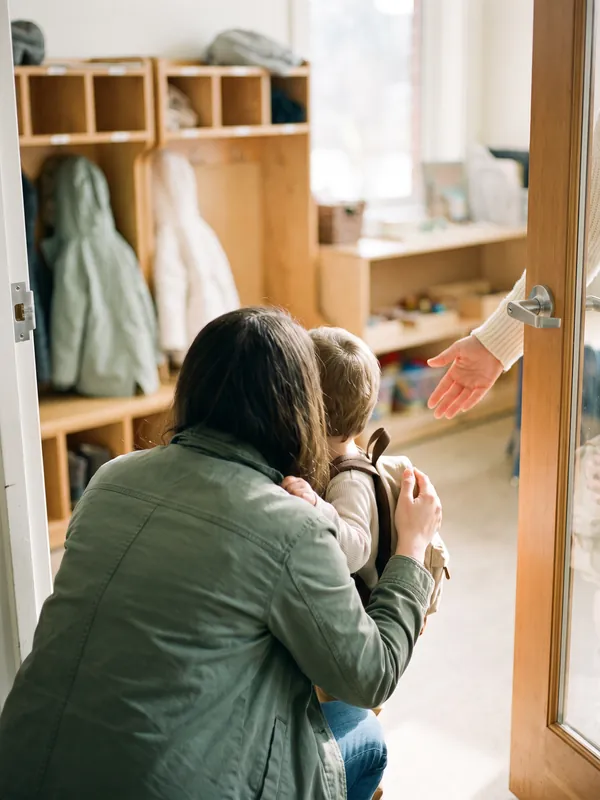
Before
- Tell your child what will happen and what you will do after you return, like “after nap time.”[3] Rehearse with role-play and take small steps.[8]
At the door
- Keep the goodbye short and calm.[3] Say it plainly: “I'm going to work. I'll pick you up after snack.”
- Use the same steps every day, like a hug, a wave at the window, then go.
- Don't sneak away. Leaving without saying goodbye can make things worse.[2]
- A comfort object from home can help.
After a break or a change
- Practice short separations first, then build up.
Common practice, limited evidence We found no test showing that one goodbye routine works better than another. These steps are common practice and our reasoning, not research results. The nearest research is a program for cautious preschoolers that taught gradual practice.[9]
6 of 6
Why do they stop crying as soon as I leave?
Our reasoning We found no research on this. Many parents and teachers describe it, and it fits the idea that the goodbye itself is the hard moment, not the whole day.
You can ask the teacher how long the crying lasts after you go and what your child does next. That tells you whether it's a short transition or something that stays with them.
When to ask for more help
Ask your pediatrician if the distress:
- is much stronger than other children's
- has lasted weeks
- spills into the whole day
- shows up in sleep, stomachaches or refusing to go
If you are worried about safety, call 988 or 911.
What the research can and can’t tell us
- The percentages come from groups of children and say nothing about yours.
- The drop-off steps are common practice. We found no study that tests them.
- We found no research on children who stop crying right after the goodbye.
More about the limits
- Our sources for typical timelines are Australian, British and American health organizations, not trials.
- This page can't tell you whether your child will grow out of it, and behavior at the door is one moment, not a description of your child.
- Staying longer, leaving sooner, or switching programs: we have no research on which is better, and it depends on your child.
Every child is wired a little differently
The quiz shows how your child handles new places, new people and change, so what you try at the door fits them. 15 minutes, free for now.
More questions parents ask
- Why does my kid melt down in public?
- Why is bedtime a battle?
- Why is goodbye so hard for my kid?
- Why is everything a battle with my kid?
- Why won't my child eat new foods?
- Why does it feel like they never listen?
- Why did my kid hit/bite/push another kid?
- Why is my child so...?
- Are my child's meltdowns normal?
Sources
- Peer-reviewed review Hanna GL, Fischer DJ, Fluent TE. Separation anxiety disorder and school refusal in children and adolescents. Pediatrics in Review, 2006;27(2):56-62. View studyA clinical review of separation anxiety.
- Health information page Raising Children Network (Australia). Separation anxiety in preschoolers. View studyA health-information page reviewed by clinicians. Australian. Not a study.
- Professional association page American Academy of Pediatrics. Soothing your child's separation anxiety. HealthyChildren.org. View studyA health-information page. Not a study.
- Government health page NHS (UK). Separation anxiety in babies and young children. View studyA health-information page. UK. Not a study.
- Longitudinal study Chronis-Tuscano A, Degnan KA, Pine DS, Perez-Edgar K, Henderson HA, Diaz Y, Raggi VL, Fox NA. Stable early maternal report of behavioral inhibition predicts lifetime social anxiety disorder in adolescence. Journal of the American Academy of Child & Adolescent Psychiatry, 2009;48(9):928-935. View study126 teens followed from infancy, mostly white and middle class. Only mothers' ratings predicted the outcome, not lab observations. It describes groups, not any one child.
- Peer-reviewed study Phillips BM, Lonigan CJ. Child and informant influences on behavioral ratings of preschool children. Psychology in the Schools, 2010. View study365 children aged 3 to 4 rated by teachers, parents and trained observers. It did not compare the same child at home and at school.
- Summary table SAMHSA / NCBI Bookshelf. DSM-IV to DSM-5 separation anxiety disorder comparison table. View studyA government summary of the DSM-5 criteria, not the manual itself.
- Professional association page American Academy of Pediatrics. My daughter is extremely shy and anxious around strangers. HealthyChildren.org. View studyA question-and-answer page from pediatricians. Not a study.
- Randomized trial Bayer JK, Prendergast LA, Brown A, Harris L, Bretherton L, Hiscock H, Beatson R, Mihalopoulos C, Rapee RM. Cool Little Kids parenting program, two-year follow-up. Child and Adolescent Mental Health, 2020. View study545 parents of cautious preschoolers, followed from about age 4 to 6. The link goes to a research digest of the paper.
The full list of everything we cite is on the Sources page.
How to read the labels.
“Supported by related research” means studies of related situations or groups back the idea.
“Common practice” means it is widely recommended but little tested.
“Our reasoning” means it is our best thinking, not a finding.
General information for parents, not medical advice or a diagnosis. Read our statement.