Are my child's meltdowns normal?
Written by Matt MaLossi, parent behind How They're Wired. Last reviewed October 19, 2026.
The short answer. Short, intense meltdowns are common in young children. In one study of 335 children aged 18 to 60 months, the most common tantrum lasted 30 to 60 seconds, and about three in four lasted five minutes or less.[1] How often and how hard they happen varies from child to child. If they are getting worse or getting in the way of daily life, raise it with your child's pediatrician.
Try first. Say very little and stay close. One short, accepting sentence, like “You're really upset. I'm right here,” is enough.
1 of 4
Why it happens
- What a meltdown looks like. In that same study, the authors propose that anger peaks at the start, while crying and wanting comfort build more slowly.[1]
- They change as children grow. Across ages 1 to 5, tantrums become less frequent but longer. A 4-year-old may have fewer meltdowns than a 2-year-old, but each one may last longer.[2]
- Body state counts. In an experiment with children aged 7 to 11, sleeping a bit less was linked to worse emotion control and behavior.[3] The authors of one tantrum study say a tantrum that starts suddenly during a stretch of poor sleep or an illness shouldn't by itself be considered alarming. That is their view, not a measured result.[4]
2 of 4
One thing to try
Common practice, partly our reasoning
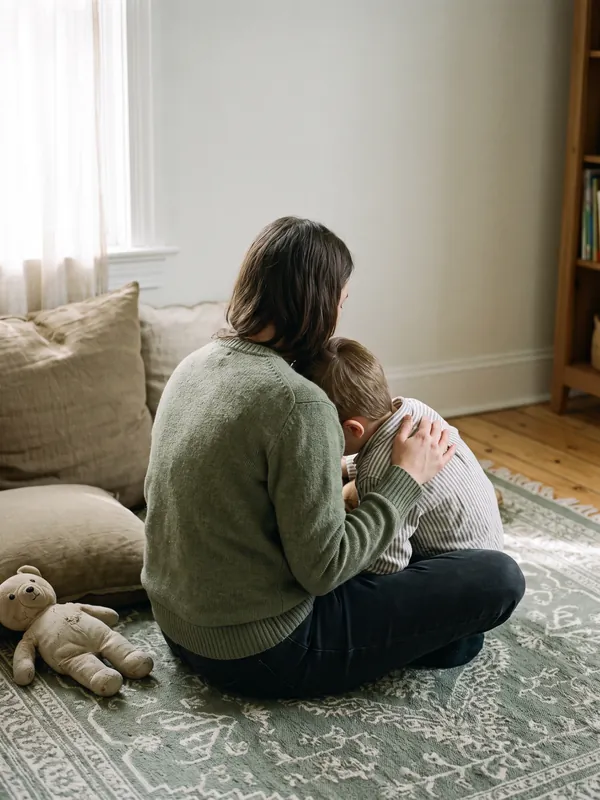
When it's happening, say very little and stay close. One short, accepting sentence, like “You're really upset. I'm right here,” is enough. Save any talking about it for later, once your child is calm. For more, see why kids melt down in public.
Fitting it to your child
- If your child feels things strongly and settles slowly: Our reasoning Expect it to take longer to settle, and plan a calm spot before you go somewhere hard.
- If leaving or switching is the trigger: Our reasoning Give a warning, then a job for the exit.
- If new or crowded places set it off: Our reasoning Go at quieter times, and tell your child what will happen.
3 of 4
When to ask for more help
One research team proposes these warning signs. Mention them to your pediatrician if you see several together:
- hitting or breaking things in about half of meltdowns
- hurting themselves on purpose
- meltdowns lasting around 25 minutes on average
- almost never calming down without you[4]
4 of 4
What the research can and can’t tell us
- The studies cover ages 1 to 6. We found little on tantrums or meltdowns in ages 7 to 10, so for older children this answer is more general guidance than research.
- The warning signs are one research team's proposal, and the authors say the dividing lines haven't been tested for clinical use.
- Matching tips to a child's temperament is our own reasoning, and no study has tested it. The descriptions are tendencies, not boxes.
Every child is wired a little differently
The quiz shows how strongly your child reacts and how they handle change, so what to try fits them. 15 minutes, free for now.
More questions parents ask
- Why does my kid melt down in public?
- Why is bedtime a battle?
- Why is goodbye so hard for my kid?
- Why is everything a battle with my kid?
- Why won't my child eat new foods?
- Why does it feel like they never listen?
- Why did my kid hit/bite/push another kid?
- Why is my child so...?
- Why does my toddler cry at drop-off?
Sources
- Peer-reviewed study Potegal M, Kosorok MR, Davidson RJ. Temper tantrums in young children: 2. Tantrum duration and temporal organization. Journal of Developmental and Behavioral Pediatrics, 2003;24(3):148-154. View studyParent narratives of 335 children aged 18 to 60 months.
- Peer-reviewed study van den Akker AL, Hoffenaar P, Overbeek G. Temper tantrums in toddlers and preschoolers: Longitudinal associations with adjustment problems. Journal of Developmental and Behavioral Pediatrics, 2022;43(7):409-417. View studyParent reports on 861 children aged 1 to 5.
- Experiment Gruber R, Cassoff J, Frenette S, Wiebe S, Carrier J. Impact of sleep extension and restriction on children's emotional lability and impulsivity. Pediatrics, 2012;130(5):e1155-e1161. View study34 healthy children aged 7 to 11.
- Peer-reviewed study Belden AC, Thomson NR, Luby JL. Temper tantrums in healthy versus depressed and disruptive preschoolers: defining tantrum behaviors associated with clinical problems. Journal of Pediatrics, 2008;152:117-122. View study279 children aged 3 to 5, healthy and clinical groups. The authors say the proposed cutoffs have not been tested for clinical use.
The full list of everything we cite is on the Sources page.
How to read the labels.
“Supported by related research” means studies of related situations or groups back the idea.
“Common practice” means it is widely recommended but little tested.
“Our reasoning” means it is our best thinking, not a finding.
General information for parents, not medical advice or a diagnosis. Read our statement.